
From winding to warping
- Yarn preparation turns spun or filament yarn into the package, ply, twist or beam that knitting and weaving need.
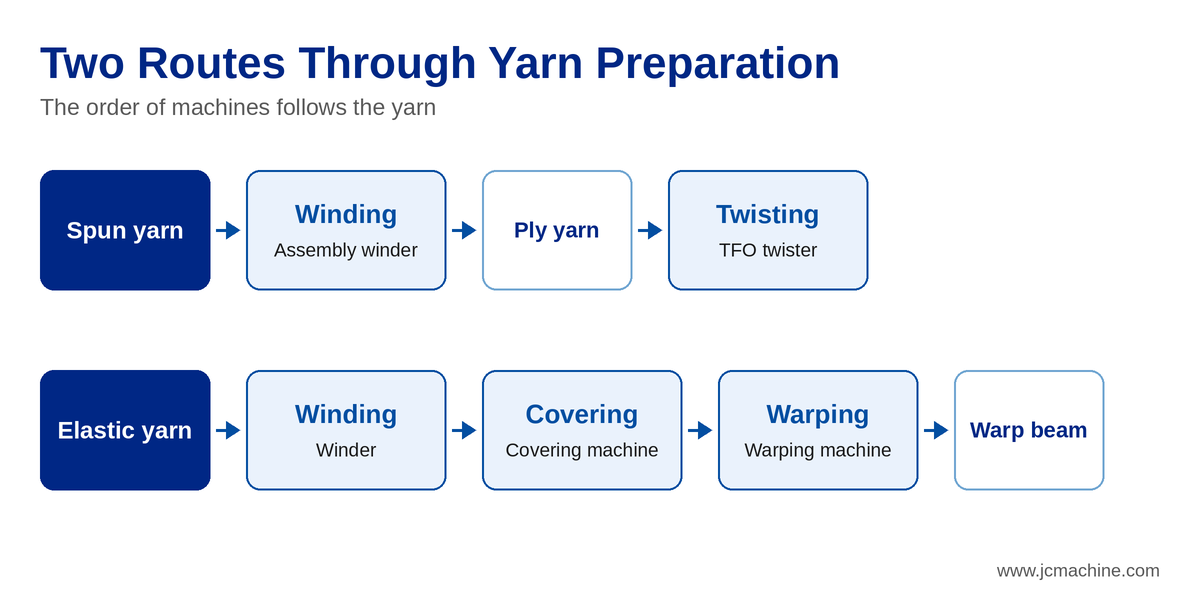
- Spun yarn is wound into ply yarn and then twisted. Elastic yarn runs from winding to covering and then warping.
- Rima Machines builds machines for each of these steps in Surat, and shows them at India ITME 2026, Hall 12, Booth H12C31.
A knitting machine or a loom can only run as well as the yarn it is fed. Before yarn reaches either one, it is wound and plied and then twisted, or covered and warped. Each step runs on a different machine, and the right machine depends on the yarn. This guide follows the yarn through each step.
What yarn preparation is
Yarn leaves the spinning mill on small ring bobbins. Winding moves it onto a larger package so that it runs continuously in later processes, and removes yarn faults on the way. Wax is often added at this stage to cut friction in later processes. From there the yarn goes on to doubling and twisting, warping, weaving or knitting.
Every machine further down the line depends on the package it receives. A package with even tension and a clean build unwinds smoothly at speed, while a poor one causes breaks and stoppages that no later machine can correct.
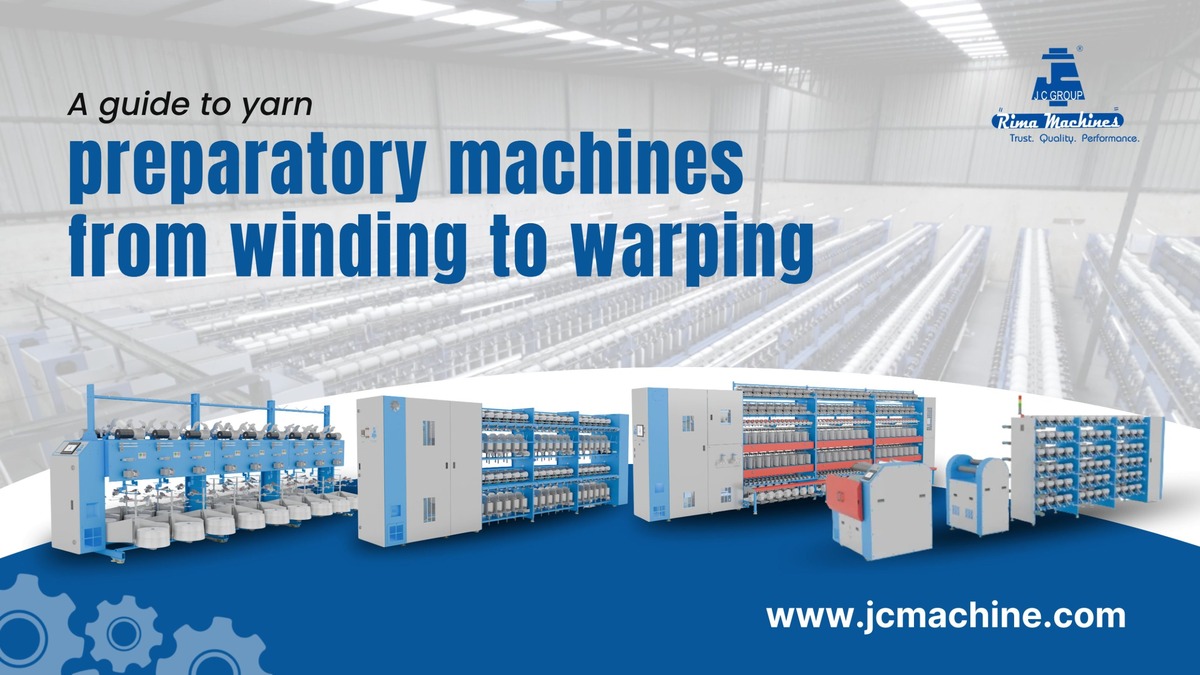
The order of the steps follows the yarn. Spun yarn is wound into ply yarn on an assembly winder, and the ply yarn is then twisted. Elastic yarn is wound, covered and then warped.
Winding with assembly winders and cops winders
Assembly winding, also called doubling, lays two or more single yarns side by side on one package without twist. This keeps the ends of the ply yarn parallel before they reach the twister. Studies of TFO twisting note that feeding two single cheeses straight to the twister can cause snarling, which is why mills assemble the yarn first.
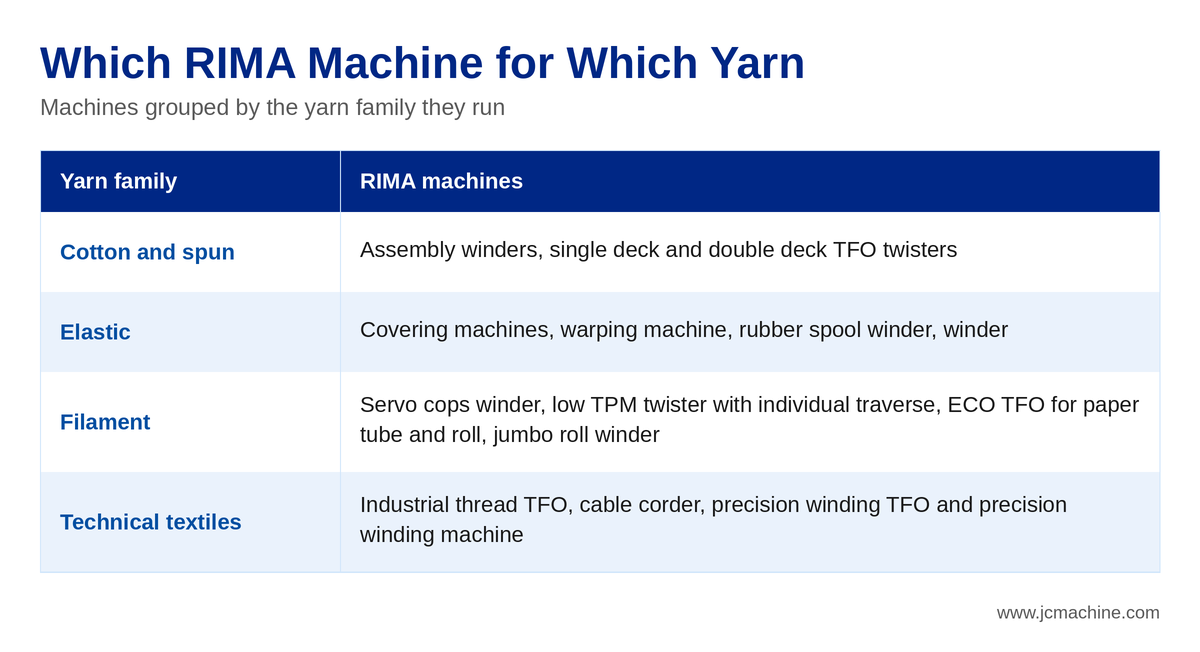
Our JC-123 Assembly Winder takes up to 4 ply with its built-in creel and 5 to 12 ply with an external creel. Each drum has its own motor, each position has its own length controller and cutter, and traverse drums come in 6, 8 and 10 inch sizes.
Filament yarn is wound onto cops. Our JC-114 Servo Cops Winder uses servo traverse with programmable package building, and runs warp, combination and multi-cycle winding. AC inverters hold the winding speed steady, and every spindle has its own length counter, cutter and brake.
Twisting with TFO twisters
A two-for-one twister puts two twists into the yarn for every turn of the spindle. The feed package sits still inside a protection pot on the spindle, and the yarn forms a balloon around it as it is drawn off and twisted. Ply twist usually runs opposite to the twist of the single yarn, most often S on Z. Mills choose TFO twisting over ring doubling for long, knot-free ply yarn and higher output. Doubling also makes the yarn stronger and more even than the singles it is made from.
For cotton and spun yarn we build single deck TFO twisters in compact, auto lifting and ECO versions, and double deck twisters in standard, auto lifting and ECO versions. The double deck ECO covers counts from Ne 20/2 to Ne 140/2, depending on the model, and its two tiers of spindles add capacity without adding floor space. It is used for cotton and blended yarn for apparel and home textiles, and for synthetic and industrial yarn. For filament there are ECO TFO twisters for paper tubes and rolls and a low TPM twister with individual traverse.
Covering elastic yarn, single and double
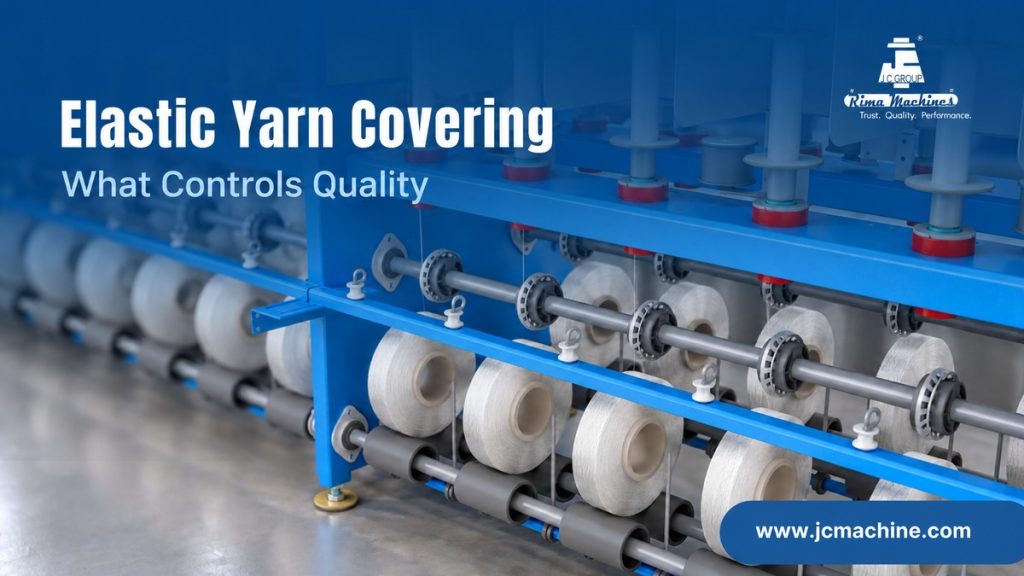
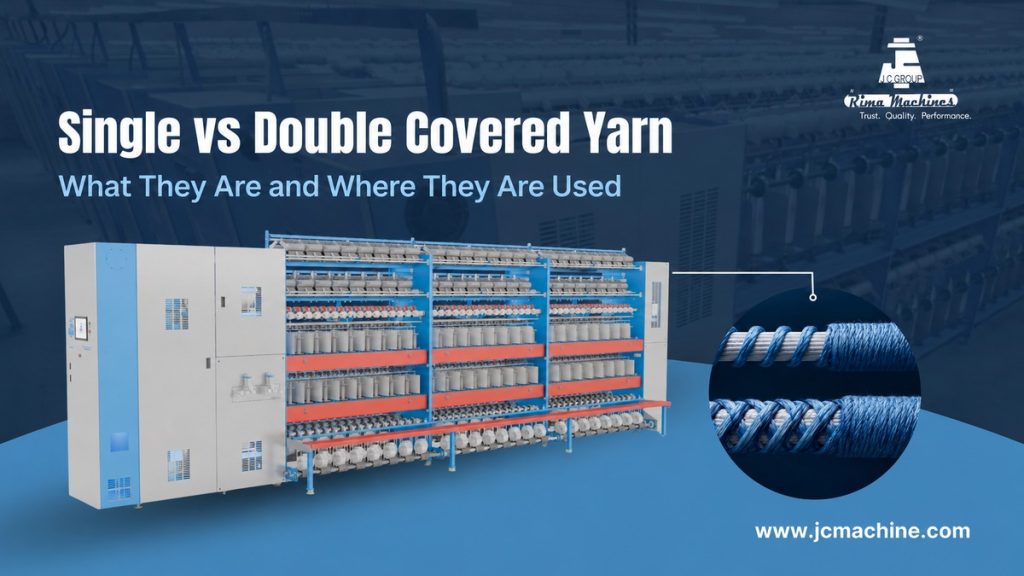
Covered yarn has an elastic core wrapped with filament. Single covered yarn has one wrap. Double covered yarn has two, laid in opposite S and Z directions, which makes it more stable and covers the core better. The cover also protects the elastic core from abrasion, so the garment keeps its stretch and recovery for longer. Covered yarn goes into hosiery, socks, lingerie and performance wear.
The RIMA Covering Machine takes rubber, Lycra, spandex and latex cores, in single and double covering and in S and Z. Settings sit on the HMI, with servo traverse and WIB bearing spindles. An ECO covering machine is also part of the range.
Warping elastic and covered yarn
Warping winds many ends of yarn in parallel from their packages onto one beam. The result is a sheet of yarn of a set length and width, with the ends spaced evenly across it and wound at almost the same tension. The beam should also have the same density across its width and from start to finish. With elastic yarn, which stretches under load, even tension across the sheet matters even more, because any difference shows up later in the fabric.
Our electronically controlled warping machine handles Lycra, spandex and latex, and single and double covered elastic yarn.
Matching machines to the yarn
Most mills work with one or two yarn families, and the machines follow from that. A sock or innerwear unit running covered yarn needs a different line from a mill making ply cotton for shirting or a plant twisting filament for industrial use.
Technical textiles have their own needs. Our JC-6-CC230 Cable Corder makes 2-ply thread from filament yarn at up to 9,000 RPM, for 840 to 5,000 denier, with knotless packages of up to 12 kg. It is used for tyre cord, carpet yarn, belts and industrial thread.
The RIMA line at India ITME 2026
Rima Machines, also known as JC Machines and part of JC Group, has been in the textile business for more than four decades and builds its yarn preparatory machines in Surat. At India ITME 2026 you can see our machines run and talk to our team about your yarn, your counts and the output you need. Find us at Hall 12, Booth H12C31, India Expo Centre and Mart, Greater Noida, from 4th to 9th December 2026.
See RIMA machines at India ITME 2026, Hall 12, Booth H12C31, or visit jcmachine.com
Frequently asked questions
What is the difference between assembly winding and twisting?
Assembly winding lays two or more single yarns side by side on one package without twist, which makes the ply yarn. Twisting then puts the twist into that ply yarn. Keeping the two steps apart gives the twister a parallel, even feed.
What does TFO mean in yarn twisting?
TFO stands for two-for-one. A TFO spindle puts two twists into the yarn for every turn it makes, so it twists ply yarn faster than a ring twister and in long lengths without knots.
What is the difference between single and double covered yarn?
Single covered yarn has one filament wrapped around an elastic core. Double covered yarn has two, wrapped in opposite S and Z directions, which makes it more stable and gives the core better cover.
Sources
- Textiles Committee, Government of India, Cone winding machine https://textilescommittee.nic.in/sites/default/files/TS_SPG_09.pdf
- Textiles Committee, Government of India, Warping https://www.textilescommittee.nic.in/sites/default/files/wvg8.pdf
- Fibre2Fashion, Study on two-for-one twisting https://www.fibre2fashion.com/industry-article/1449/study-on-two-for-one-twisting
- Textile School, Types of doubling, uses and objectives https://www.textileschool.com/amp/421/types-of-doubling-uses-and-objectives/
- Textile Points, What is a two-for-one twister https://textilepoints.blogspot.com/2017/01/what-is-two-for-one-twister-tfo.html
- Fulgar, Single and double covered yarns https://www.fulgar.com/en/technology/217/polyamide-66-single-and-double-covered-yarns
- Rima Machines, product pages https://www.jcmachine.com/