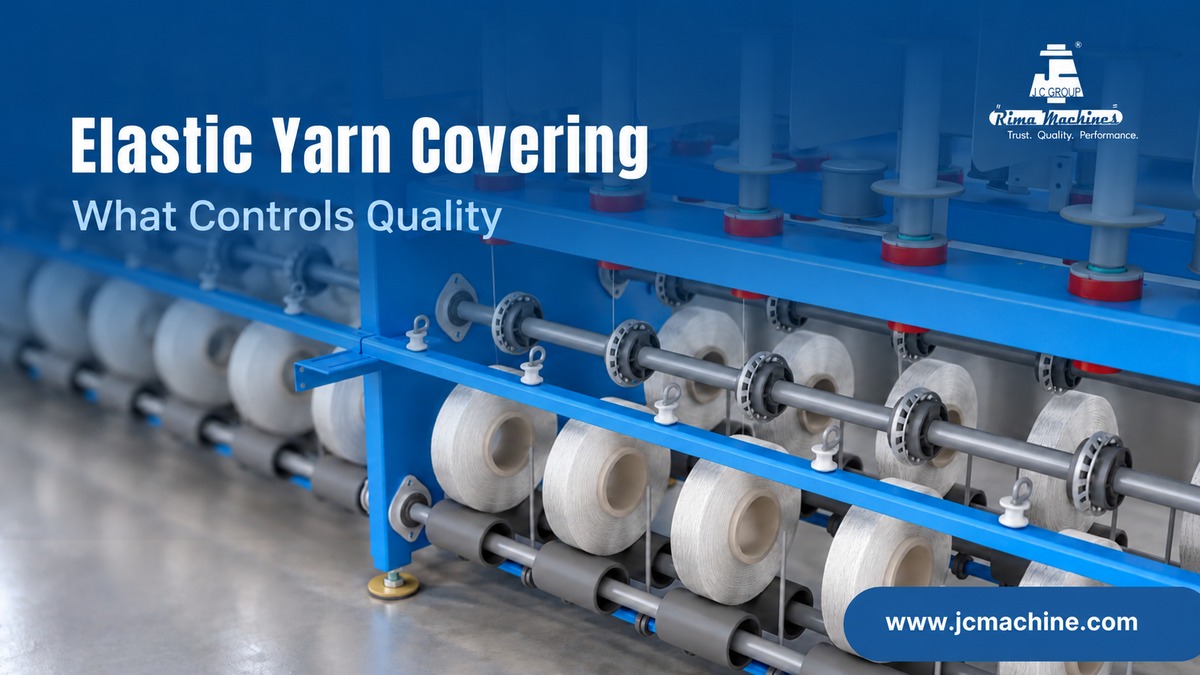

What Controls Quality
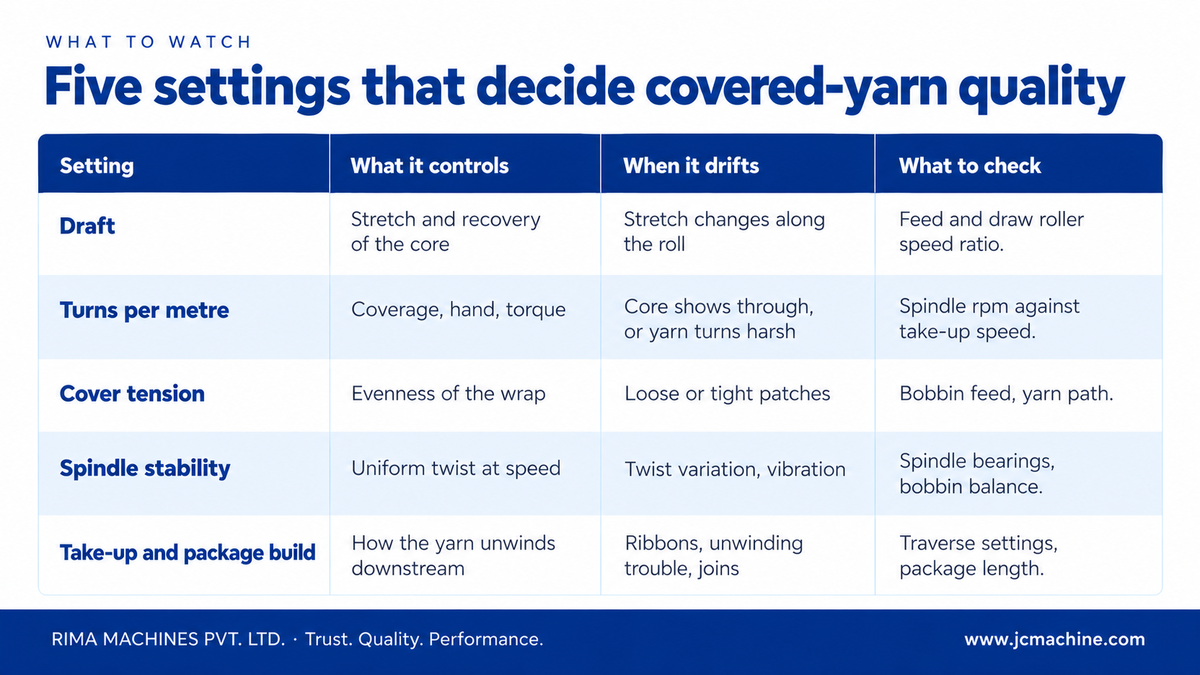
Elastic yarn covering quality is only as good as the most inconsistent metre, because the knitting or weaving machine uses every one of them. – Five settings decide the result, namely draft, cover tension and twist, spindle speed, take-up and package build. – Electronic control and stable spindles keep those settings where they were set, shift after shift.
A knitting unit running covered yarn into waistbands, socks or compression stockings needs every metre to behave like the one before it. When a covering machine lets one setting drift, the fault rarely shows on the covering floor. It shows later, as a band of different stretch in the fabric, a patch where the core peeps through or a stocking that does not give the pressure on its label. This article looks at the settings that decide covered-yarn quality and how a covering machine keeps them steady.
Why consistency drives elastic yarn covering quality
Elastic yarn covering quality is how evenly a covering machine holds the stretch of the elastic core and the wrap of the cover yarn along every metre. It depends on five settings, which are draft, cover tension and turns per metre, spindle speed and stability, take-up, and package build.
A covered yarn is two yarns working as one, a stretched elastic core and a cover that wraps it. If either changes along the length, the fabric shows it.
Researchers studying the process put it plainly. Variation in how far the spandex is drawn causes inconsistent tension and affects the structural stability, resilience and uniformity of the yarn. Buyers know this too, which is why serious specifications now record draft, cover level and test method as well as the elastane percentage.
For compression hosiery the stakes are clear. Stockings are graded by pressure in mmHg, and the firm grades of 20 to 30 and 30 to 40 mmHg are worn on medical advice. A yarn that drifts makes a stocking that drifts.
Draft, or how far the elastic core is stretched (spandex draft ratio)
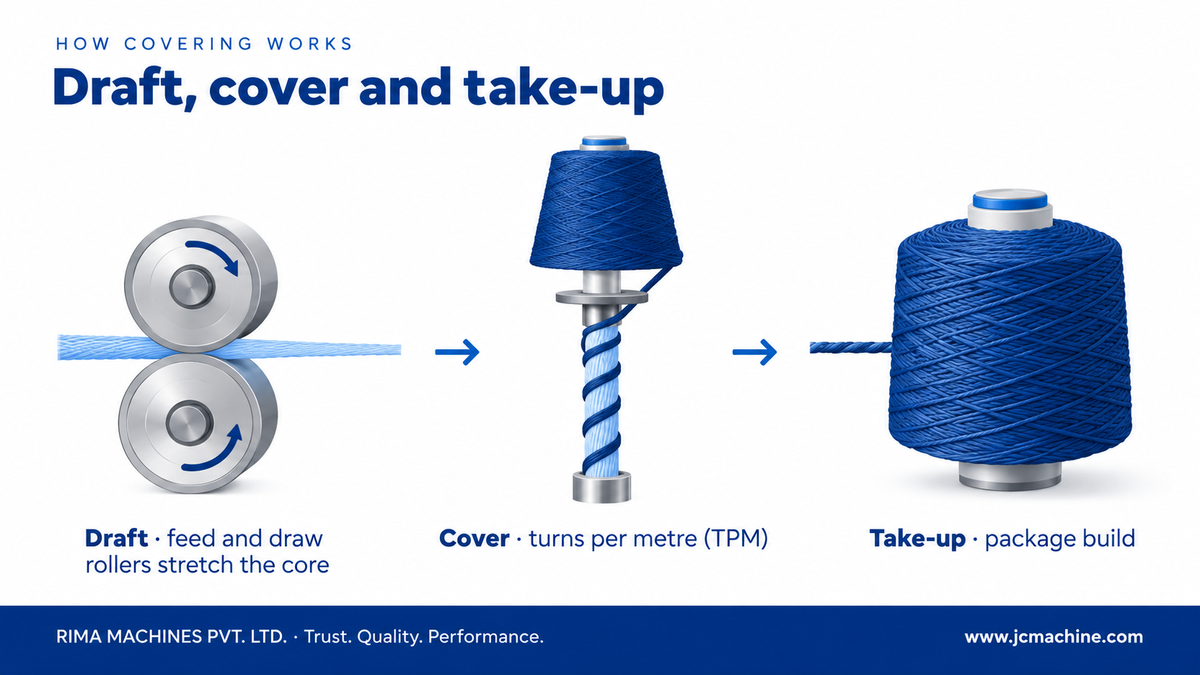
Draft, or draw ratio, is how much the elastic core is stretched before the cover is wrapped around it. It is set by the speed difference between the roller feeding the spandex and the rollers that draw it forward. One covered-yarn maker calls the drawing roller “the most critical part” of the system for product quality.
Typical draw ratios sit between about 2 and 4. In a 2020 study by Feng, Liu and Yang, trials ran at ratios from 2.65 to 3.24, and the core’s tension rose as the ratio went up. That relationship is the useful part, because if the draft is held steady, the elastic properties are held steady.
When the draft wanders, the yarn wanders with it. More draft gives a yarn that pulls back harder, and less gives a softer one. On the fabric, that can show as stretch that changes from one end of a roll to the other.
Cover yarn tension and twist, and the covered yarn TPM calculation
Twist in covered yarn is counted as turns per metre (TPM), the number of times the cover goes round the core in one metre. It comes from two numbers on the machine. Divide spindle revolutions per minute by metres taken up per minute and you have the TPM.
As an illustration only, a spindle at 12,000 rpm, the speed used in the 2020 study’s trials, with yarn taken up at 20 metres a minute, lays 600 turns on every metre. The covered yarns measured in that study came out between 570 and 665 TPM.
One yarn maker recommends 600 to 800 TPM for single covered yarn, the range that balances coverage, hand feel and torque. Go lower and the core starts to show through the wraps. Go higher and the yarn turns harsher and twistier. Cover yarn tension works alongside this, since an even feed from the bobbin gives an even helix.
Covering machine spindle speed and stability
The covering spindle is hollow. The core runs up through it, and the bobbin of cover yarn sits on it and spins. That bobbin is the limit. One covering patent notes that the maximum speed is restricted by the bobbin’s mass and dimensions, so only a limited amount of cover yarn can be carried if the spindle is to run fast enough.
Small bobbins bring their own problem, because the machine stops more often for changes. Steady speed matters more than top speed. A spindle that runs a little slower but holds its speed exactly gives more even TPM than one that runs fast and wavers. Any vibration in the spindle or wobble in the bobbin goes straight into the twist.
Take-up and package build, avoiding ribbon defects
The last step is winding the covered yarn onto a package that the next machine can use. Two things matter here.
The first is length. The same patent records that short take-up packages forced mills to join lengths together, which sent knots to the knitting machine.
The second is how the yarn is laid. If the yarn keeps landing in the same place on the package, it stacks into “ribbons”, and a 2016 paper in Fashion and Textiles describes these patterns as a defect that disrupts open-wound packages used for dyeing, warping and weaving. Since covered yarn goes on to warping, a clean package matters well beyond appearance.
Electronic traverse is the modern answer. A servo-controlled traverse lets the traverse length and wind ratio be set in software rather than changed with mechanical parts, which means faster setup changes and more control over package shape.
How RIMA covering machines control these settings
Each of the five settings above lands on a specific part of the machine, and that is how we build our covering machines for spandex and rubber yarn.
Draft. Our Double Covering ECO Machine draws the core through a 3-roller drafting system, with the draft ratio set through gears, so the stretch is fixed before the cover goes on.
Speed ratios. On our ECO machines, input, output, both covering decks and the take-up each run on a separate motor with an AC variable frequency drive, so each speed can be set on its own.
Package build. A servo traverse motor and drive can be supplied as an option on our Single/Double Covering ECO Machine, and the Double Covering ECO Machine can wind onto a direct beam or onto cheese and cone packages to suit the next process.
At the top of the range. The RIMA Covering Machine is fully electronic, set from HMI controls, builds packages with a servo traverse and runs on WIB bearing spindles. Setting the machine through the HMI makes it easier to bring every position to the same setting and repeat it for the next lot, and stable spindles mean steadier twist.
In the line, the covering machine sits between winding and warping. Cover yarn is wound onto bobbins first, covered next, and then the packages go to warping. Every setting above is about handing the warping section a package it can trust.
A machine that holds its settings lets the operator look after the odd spindle that needs attention instead of chasing all of them, and that steadiness is what the yarn buyer is really paying for.
Explore RIMA covering machines at jcmachine.com
Frequently asked questions
What is draft in spandex covering? Draft in spandex covering is how far the elastic core is stretched before it is covered, set by the speed ratio of the feed and drawing rollers. Typical draw ratios sit between about 2 and 4.
How is TPM calculated on a covering machine? Covered yarn TPM is calculated by dividing spindle speed in revolutions per minute by take-up speed in metres per minute. The result is the number of cover turns on each metre of yarn.
What causes the elastic core to show through covered yarn? The core usually shows through because of too few turns per metre or uneven cover tension, which leave gaps between the wraps.
Why does package build matter for covered yarn? Poorly built packages, such as those with ribbons, unwind unevenly in warping and weaving, which causes stoppages and faults downstream.
Sources
- High Efficiency Covering Technology for Covered Yarns Production · Feng, Liu & Yang (2020)
- Technology Development of Spandex Covered Yarn · Wintex
- Single Covered Yarn (SCY) · Polylion
- Core-Spun vs Covered Stretch Yarn · Topade Textile
- Compression stockings · Wikipedia
- US6718748B1, Yarn covering apparatus and method · Google Patents
- Suitable traverse ratios for step precision winding · Fashion and Textiles (2016)
- US6776367B2, Servo-controlled traverse mechanism for winder · Google Patents
- Single/Double Covering ECO Machine · RIMA Machines
- Double Covering ECO Machine · RIMA Machines