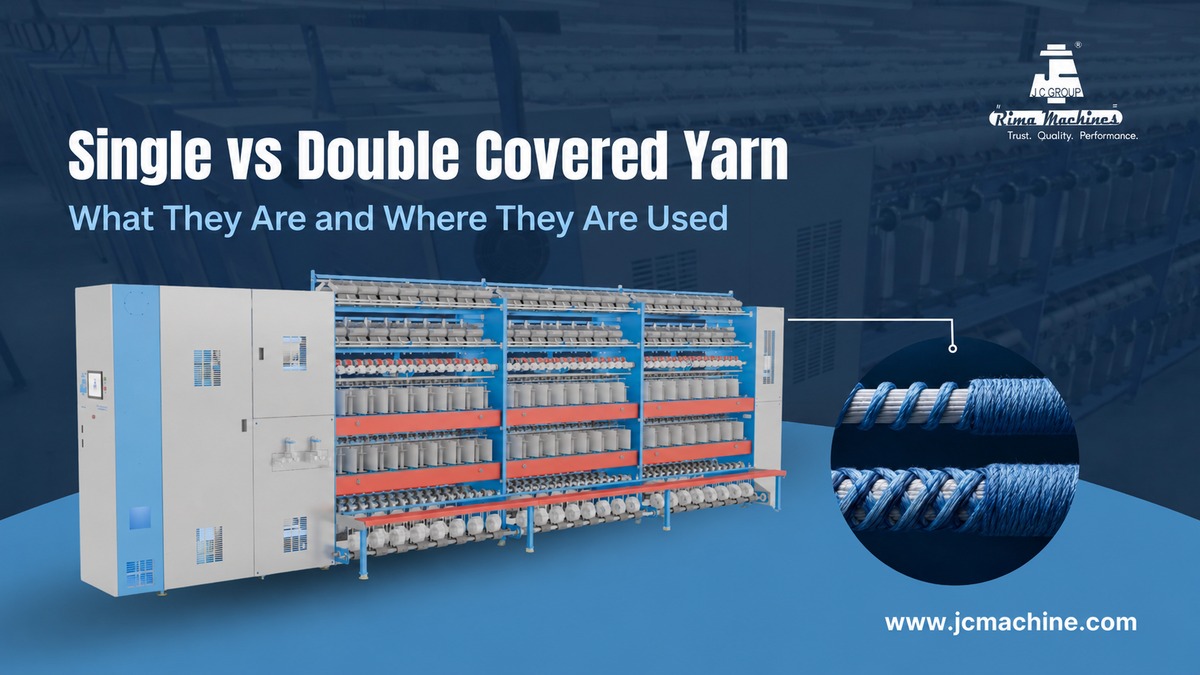

What They Are and Where They Are Used
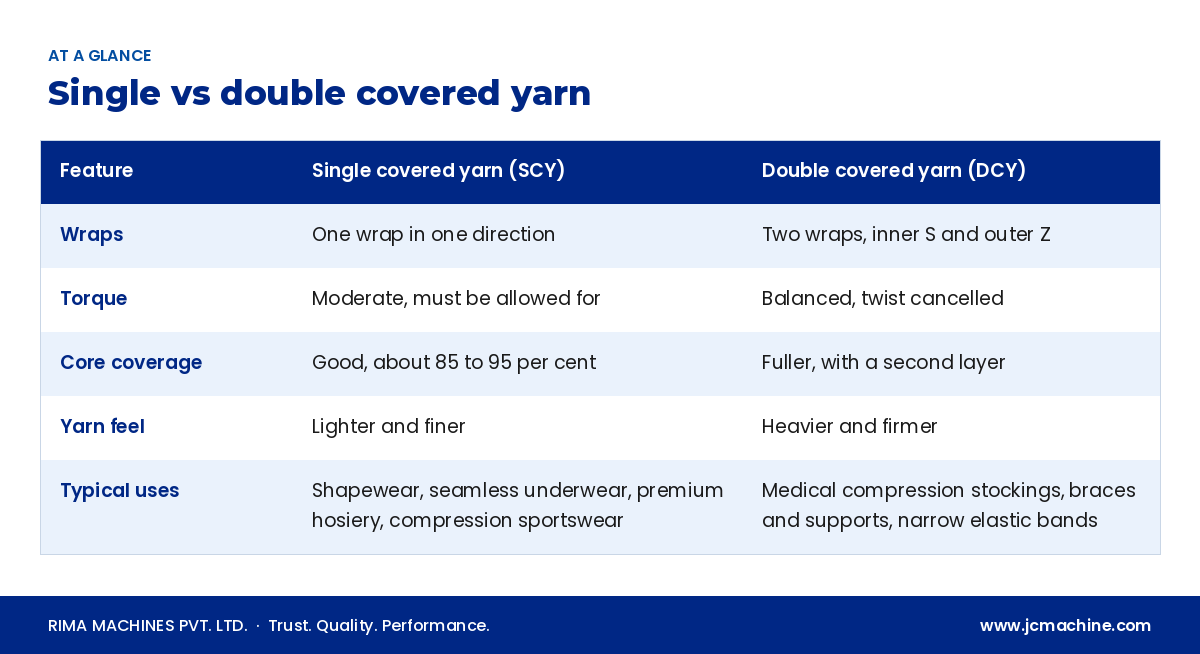
Covered yarn is an elastic core wrapped in a hard yarn, so the stretch can be knitted or woven without the core showing or breaking. – Single vs double covered yarn comes down to the wrap, either one wrap or two wraps in opposite directions that cancel torque. – The end product decides the yarn. Fine hosiery and knitted-to-shape innerwear lean single, and medical compression leans double.
School socks that stay up all day, a waistband that keeps its grip after months of washing and a compression stocking that holds the same pressure through a long shift all rely on the same small piece of engineering. It is an elastic thread hidden inside a wrap of nylon or polyester. Whether that wrap goes round once or twice changes how the sock, the stocking or the waistband behaves, and this article explains the difference and where each type is used.
What covered elastic yarn actually is
Covered elastic yarn is a stretch yarn made by wrapping a hard filament, usually nylon or polyester, around a stretched elastic core of spandex or rubber. Single covered yarn has one wrap, and double covered yarn has two, laid in opposite directions. The cover protects the core and lets mills knit or weave it like an ordinary yarn.
The elastic core most mills use today has a short history. Spandex was invented in 1958 by chemist Joseph Shivers at DuPont. The fibre was first released as “Fibre K” and was commercialised by DuPont in 1962 under the name Lycra. It can stretch to about five times its length. Europe calls it elastane, and North America calls it spandex.
Bare elastane is rarely knitted or woven on its own. In clothing it is usually blended with cotton or polyester and makes up only a small share of the fabric, so the garment keeps the look and feel of the other fibre.
Covering is one of the main ways to do that. The core is stretched (drafted) as it runs through a hollow spindle. Meanwhile, a bobbin of cover yarn on that spindle spins around the core and lays a helix of filament over it. When the yarn relaxes, the core pulls back and the wraps bunch together, protecting it.
The core is not always spandex. In Surat’s narrow-fabric trade, for example, elastic tape makers list covered rubber elastic yarn with a rubber core and a polyester cover.
Single covered yarn, one wrap and a lighter build
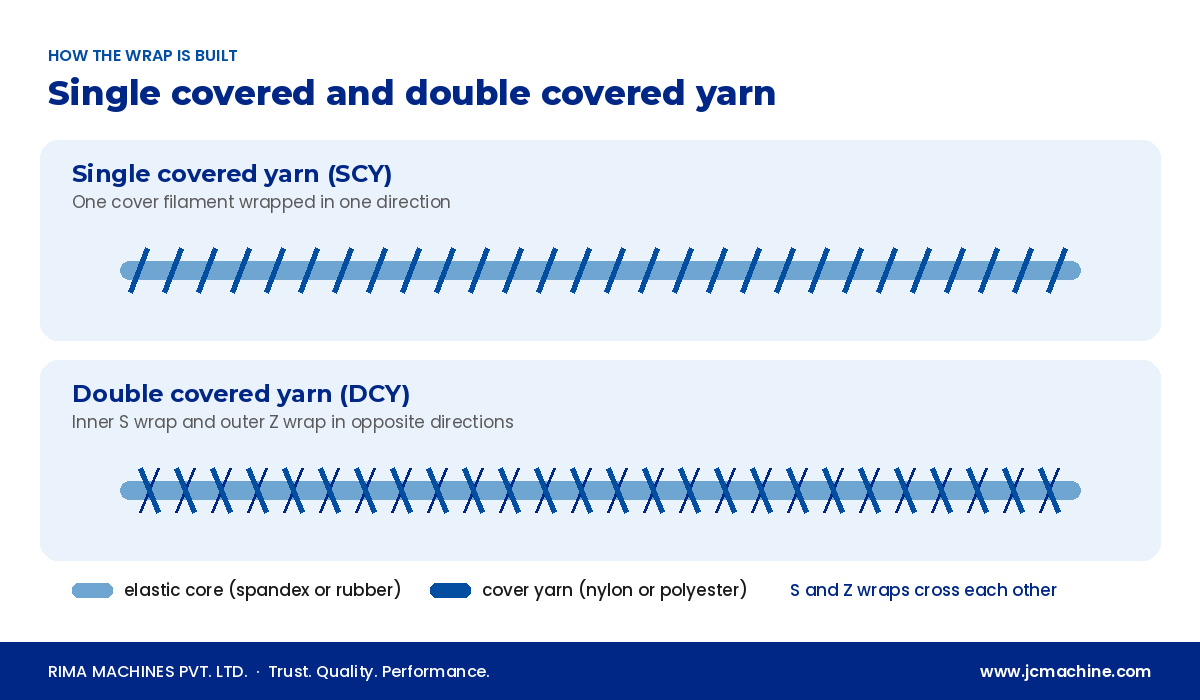
Nylon spandex and polyester spandex yarns are commonly single covered. In single covered yarn (SCY), one filament of nylon or polyester is wrapped around the stretched spandex core at a set number of turns per metre (TPM). One yarn maker recommends 600 to 800 TPM as the range that balances coverage, hand feel and torque. The same maker puts typical core coverage at 85 to 95 per cent.
Because all the wraps run one way, single covered yarn keeps some residual twist. The same supplier rates its torque, or spirality, as “moderate”. Knitters and fabric designers have to allow for it.
What single covering gives in return is a thinner, lighter yarn. It is specified for shapewear, circular-knit, knitted-to-shape underwear, compression sportswear and premium hosiery, where a fine, smooth fabric matters as much as stretch.
Double covered yarn for compression stockings, two wraps and balanced
Double covered yarn (DCY) adds a second layer. The inner wrap goes round the core in an S direction, and the outer wrap goes over it in a Z direction. Because the two layers turn opposite ways, the twist of one cancels the twist of the other. The yarn lies flat with no tendency to skew or curl the fabric.
Two layers also mean fuller cover. Suppliers point to better abrasion resistance, strength and uniformity than a single wrap. The cost is a heavier, firmer yarn that uses more cover filament.
That balance and steadiness is why double covered yarn is specified for Class I, II and III medical compression stockings, orthopaedic braces and supports, and post-surgical garments. It is also used for hosiery and tights that have to last.
End uses of covered yarn in socks, innerwear, elastic tapes, compression hosiery, activewear and stretch denim
Socks. Covered spandex is a standard yarn for socks, which is what keeps a sock in place through a full day of wear.
Innerwear and elastic tapes. Circular-knit, knitted-to-shape underwear and shapewear use single covered yarn. Waistband and garment tapes are woven or knitted from covered elastic yarns, including the rubber-core covered yarns that Surat tape makers produce.
Compression hosiery. A graduated compression stocking is tightest at the ankle and gradually less tight towards the knee and thigh. Pressure is graded in mmHg. 15 to 20 mmHg is a mild grade, while 20 to 30 and 30 to 40 mmHg are firm grades where medical advice is recommended. Holding a defined pressure, wash after wash, is the job double covered yarn is chosen for.
Activewear. Compression sportswear uses single covered yarn where a fine, light fabric is wanted, and heavier compression garments and supports move to double covered yarn.
Stretch denim. Here the picture is different. Cotton-faced stretch denim usually puts the elastane into the weft as core-spun yarn, where cotton fibres are spun around the core. A 2021 study in the Journal of Engineered Fibers and Fabrics compared exactly these core-spun and dual-core weft yarns in denim. Covered yarn is a different structure. A fabric spec should say which one it means, because the two are not interchangeable even at the same elastane percentage.
Single vs double covered yarn, choosing the right yarn for the product
When buyers weigh single vs double covered yarn, the answer starts from the fabric rather than the yarn. Four questions settle most cases.
- Does the fabric need to lie dead flat? If spirality would show, as in a fine-gauge stocking or a wide tape, double covering removes the torque.
- How fine and light must it be? Single covering gives a thinner yarn and a smoother, finer fabric.
- How long must the stretch hold? A garment rated to a pressure class or expected to survive heavy wear is a double covered job.
- What should the surface feel like? A filament cover gives a smooth face, and a cotton face points towards core-spun instead.
Then write the specification properly. Elastane percentage on its own does not describe a yarn. Buyers increasingly ask for the construction, core denier, draft, cover level and the tests used to check them.
How the RIMA Covering Machine fits this process
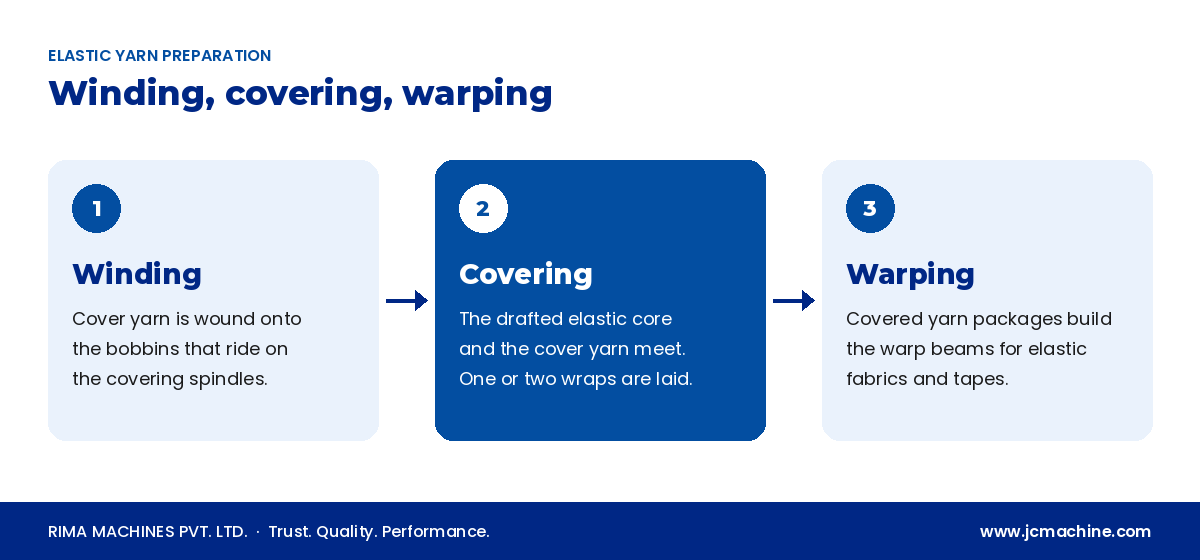
Covered yarn sits in the middle of the preparatory line, and the order matters. Winding comes first, then covering, then warping.
Winding comes first because the cover yarn has to be put onto the bobbins that ride on the covering spindles. Covering is where the drafted elastic core and the cover yarn meet. The finished packages then go to warping, which builds the warp beams for woven and warp-knitted elastic fabrics and tapes.
RIMA builds covering machines for both kinds of yarn. Our Single/Double Covering ECO Machine is designed for single and double covering of Lycra, spandex or rubber threads, and converts easily between the two. The Double Covering ECO Machine is built for spandex yarns and latex rubber threads, with a 3-roller drafting and take-up system for uniform covering. At the top of the range, the RIMA Covering Machine is fully electronic, set and monitored through HMI controls, lays yarn on the package with a servo traverse and runs on WIB bearing spindles.
Whether the end product is a school sock, a waistband or a medical stocking, the wearer only notices the yarn when it stops doing its job. That is decided on the mill floor, one wrap at a time.
Talk to RIMA Machines about covering machines for your yarn at jcmachine.com
Frequently asked questions
What is the difference between single and double covered yarn? Single covered yarn has one cover filament wrapped around an elastic core. Double covered yarn has two, wrapped in opposite directions, which cancels torque and gives fuller coverage.
Which covered yarn is used for compression stockings? Double covered yarn is the usual choice. Medical compression stockings in Class I to III are typically made with double covered yarn, because its balanced structure helps hold a steady pressure.
Is covered yarn the same as core-spun yarn? No. Covered yarn wraps filament around an elastic core, while core-spun yarn spins staple fibres such as cotton around it. Stretch denim weft is commonly core-spun.
What does TPM mean in covered yarn? TPM, or turns per metre, is the number of times the cover yarn wraps around the elastic core in one metre of covered yarn. It affects coverage, hand feel and torque.
Can one machine make both single and double covered yarn? Yes. Convertible machines such as RIMA’s Single/Double Covering ECO Machine can be set up for single or double covering of Lycra, spandex or rubber threads.
Sources
- Spandex · Wikipedia
- Joseph Shivers · Wikipedia
- High Efficiency Covering Technology for Covered Yarns Production · Feng, Liu & Yang (2020)
- Single Covered Yarn (SCY) · Polylion
- Double Covered Yarn (DCY) · Polylion
- Double Covered Yarn, The Ultimate Guide · Textile-yarn.com
- 3tee Elastic Pvt Ltd, Surat
- Compression stockings · Wikipedia
- Cotton covered elastomeric hybrid yarns and denim · Journal of Engineered Fibers and Fabrics (2021)
- Single/Double Covering ECO Machine · RIMA Machines
- Double Covering ECO Machine · RIMA Machines