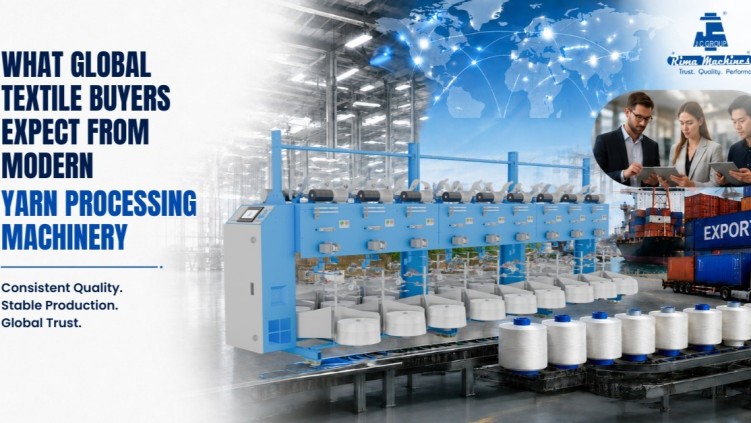

The textile industry has always developed in line with customer needs. Just as the 20th century witnessed mechanisation, the 21st century is witnessing automation and smart manufacturing. The customer is now demanding good quality, rather than just focusing on prices. On the same lines, international buyers evaluate product quality, consistency, operational efficiency, and the product’s supply chain before placing an order.
As the textile market is no longer limited by geography, textile manufacturing has become highly competitive, leading textile producers to invest in modern yarn-processing machinery to deliver the highest-quality products and attract more buyers. This investment pays back through long-term growth in the business and profits.
Starting with popular global brands, fashion houses, and retailers, textile sourcing companies are seeking higher standards from manufacturers, with consistent product being the key across large volumes and shorter delivery timelines. Simultaneously, rising labour costs, stringent international quality benchmarks, and sustainability criteria have been pushing manufacturers to improve operational efficiency through advanced machinery solutions.
Export-focused textile manufacturing relies on product consistency. It is always large-quantity orders with exactly the same quality batch to batch. When the quality of yarn affects the fabric appearance, weaving performance, and overall product quality, even a minor inconsistency can be amplified by multiple folds in the resultant fabric, leading to production delays, rejected shipments, and loss of confidence, respectively. In such cases, the use of advanced machinery helps the yarn manufacturers in maintaining uniform yarn quality by allowing precise control over the parameters throughout the production process, and meeting buyer specifications.
Stable yarn processing directly translates to product reliability and buyers’ confidence. A stable processing unit results in less yarn breakage during downstream operations and reduced waste and rework. Global buyers often purchase from suppliers who deliver predictable, consistent yarns with every shipment. Manufacturers who consistently deliver high-quality yarn also reap the benefits of long-term relationships with international clients and a strong reputation.
Automation has made work easier for operators and manufacturers alike. It has now become the bare minimum requirement in textile manufacturing. Buyers have consistently preferred suppliers with automated production facilities, due to lower human error, improved production monitoring, and greater process transparency. Controlled systems allow the manufacturers to adapt to changing requirements while adhering to quality standards. Buyers expect shorter lead times without compromising the quality.
When manufacturers face manufacturing challenges while planning to go global. Rima Machines stands right by their side because we understand that efficiency is not just printed on pamphlets; it has to be achieved in the manufacturing units. Our yarn manufacturing solutions are designed and customised to help businesses achieve consistency, productivity, quality, and efficiency. These qualities allow businesses to compete in the global market and meet standards across all batches. Rima Machines combines engineering with industry-focused innovations with automation for large-scale manufacturing, reducing downtime and giving consistent output quality. As buyer demands become more specific and standards become more stringent, stable manufacturing practices with precise automation are the key to catering to the global market, and Rima Machines pioneers them.